Freestyle street dance and Laban Movement Analysis (LMA) are often positioned as opposites – one intuitive, the other analytical. In practice, they describe the same movement truths from different perspectives, where freestyle is lived and Laban is observed.
When combined, they form a powerful framework for movement of storytelling on camera. This is especially relevant for film and brand campaigns, where choreography must feel instinctive and emotionally real, yet remain legible to directors, editors, stylists, and global creative teams.
This article explores how integrating freestyle dance with Laban Movement Analysis creates choreography that is both authentic and translatable – a key requirement in contemporary screen-based storytelling.
Core Philosophy: Intuition vs. Translation
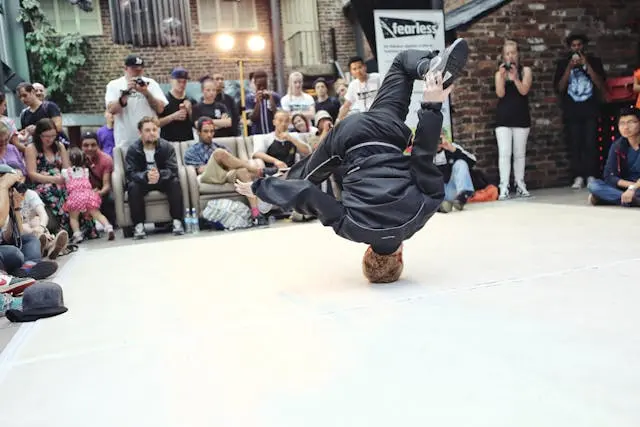
Freestyle street dance emerged in the late 1960s and early 1970s in New York City, rooted in African American and Latinx communities. It developed as a spontaneous, improvisational form of social dance, incorporating elements of breaking, locking, popping, waacking, disco, and later electronic and club styles.
Unlike fixed choreography, freestyle prioritises:
- Individual expression
- Musical responsiveness
- Cultural context
- Real-time decision making
Fast forward to today, and the essence of freestyle remains unchanged. It begins inside the body. The dancer moves first and analyses later. This allows for:
- Movement to emerge in real time
- Somatic, sensation-led decision making
- Expression to outweigh explanation
Because freestyle thrives in uncertainty, it often produces the most authentic movement – something increasingly valued in film and luxury brand storytelling.
Laban Movement Analysis: A Shared Language for Movement
Laban Movement Analysis (LMA) was developed by Rudolf Laban in the early 20th century as a system for observing, describing, and interpreting human movement. Rather than prescribing choreography, LMA offers a framework for understanding how movement happens.
At its core, LMA analyses movement through:
- Space – pathways and focus
- Time – speed and urgency
- Weight – force and intention
- Flow – control versus release
Laban does not tell a dancer what to feel. Instead, it provides language to describe how feeling manifests physically. This makes it particularly valuable in screen-based contexts, where movement must be communicated clearly across departments and cultures.
Effort Qualities: Translating Feeling for Multi‑Disciplinary Teams
In freestyle, effort is instinctive. Street dancers naturally sense weight, timing, and energy, often using style-specific terminology that makes sense within their own communities.
On set, however, movement must be communicated not only to dancers, but also to directors, cinematographers, fashion houses, editors, and producers. This is where Laban’s Effort Qualities become essential:
- Weight – Light to Strong
- Time – Sustained to Sudden
- Space – Direct to Indirect
- Flow – Free to Bound
A freestyle dancer gliding across the floor already understands light weight and free flow. Laban simply provides vocabulary for that embodied knowledge. So for film and luxury brand campaigns, this translation allows movement to align precisely with creative intent.
E.g. Soft, sustained effort for couture and fragrance narratives, or sharp, direct effort for street‑based or character‑driven drama. This ‘Effort language’ bridges instinct and intention – ensuring emotional clarity without sacrificing authenticity.
World‑Building on Set: Embodiment, Space, and Shape
Scripts and creative briefs usually describe where and when a story takes place. Movement, however, is often left implicit.
Consider a film set on the east coast of Australia, following a young dancer navigating dyslexia while fighting to save her neighbourhood from commercial development. Freestyle allows the performer to physically explore her character’s internal world – her tension, hope, resistance – through improvisation.
But if that movement needs to be refined, repeated, or reframed for camera, Laban’s Shape Theory provides clarity through terms like:
- Rising / Sinking
- Expanding / Condensing
- Advancing / Retreating
By articulating movement choices through shape, dancers and movement directors can communicate intention clearly to film directors and cinematographers. This shared understanding helps determine how movement, costuming, and product placement read on camera.
In screen environments – where rehearsal time is limited – the combination of freestyle improvisation and Laban’s translatable language ensures efficient production without flattening creative depth.
Rhythm on Camera: Groove vs. Structure
Freestyle dancers live inside rhythm. Groove, breath, syncopation, pauses, and musical texture guide timing intuitively.
The Laban language does not replace this embodied musicality. Instead, it makes rhythm observable and repeatable for screen production. This is crucial when choreography must:
- Be filmed across multiple takes
- Match editing rhythms
- Remain consistent across regions or campaigns
Structure allows rhythm to be captured, edited, and reproduced – without stripping movement of its soul.
Why This Matters for Storytelling on Screen
Film directors and luxury brands increasingly require movement that feels authentic, communicates emotion instantly, and translates across cultures and markets. And while freestyle delivers emotional truth, Laban ensures clarity, consistency, and alignment. Together, they allow choreography to be felt first and understood second – the ideal sequence for compelling storytelling.
The Studio Sessions Approach
At Studio Sessions, we don’t choreograph with Laban or against freestyle. We let freestyle lead, and use Laban as a lens.
This approach allows us to create movement that is instinctive, culturally grounded, and emotionally resonant – while remaining legible to global creative teams, directors, and brands.
You don’t need analytical language to feel movement. But when you want to share that movement across screens, regions, and disciplines, a translatable framework matters.
Contact us for freestyle choreography with a Laban lens – designed for fashion, film, music, travel, and storytelling on camera.